skip to main |
skip to sidebar
Last weekend, some of my friends from my study abroad program and I decided to go to Killarney and Kerry (mainly to see the ring of Kerry). Friday morning we had to catch a 7:00 a.m. bus to Killarney. This required waking up before 6 a.m. since we needed to give ourselves enough time to walk down there and to not feel panicky about missing the bus.Like zombies, we walked downtown to catch the bus all the while hoping that we'd be able to go back to sleep on the bus. We had no idea what kind of bus ride awaited us. I have come to the conclusion that anyone around here can get a license to drive a bus! This bus driver (and every driver for the rest of the trip) seemed to have a personal problem with people sleeping on the buses. At every stop, it seemed as if he was slamming on the brakes! There was one time that I was drifting off to sleep as he came to a stop, and I actually fell off of my seat! Every time the drivers would start going again, it seemed as if they were trying to peel out. Needless to say, it was not the most restful bus ride.By the time we got to Killarney (six hours later!) we were completely and utterly exhausted, BUT we knew that we did not want to waste an entire day so we decided to go visit Killarney National Park which was only a stone's throw away from the hostel we were staying in. Here's where we were!View Larger MapIf you can see it, underneath the "A" is a green spot; this is Killarney National Park. It may seem small on that map, but it is actually 25,425 acres. It was Ireland's first national park, and was established in 1932 when the Muckross Estate was donated to the Irish state.On our way there, we walked by St. Mary's Cathedral. Construction of this cathedral began in 1842, but had to cease in 1848 when the devastation of the Great Potato Famine was at its peak. Its construction resumed in 1853 after the famine had passed and was not finished until 1912.In one side of the Cathedral is a large tree planted over the mass grave of many famine victims (it is not visible in this picture). It is a memorial of all of the children lost to starvation and disease during that tragic time. From there, we walked into Killarney National Park. This cute little building greeted us in the entrance:
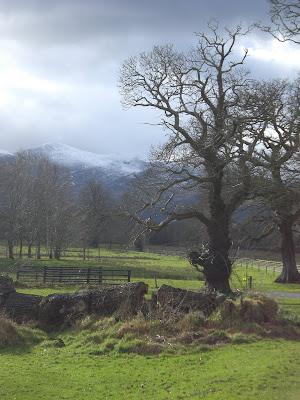
 I don't know what it is for, but it was definitely cute. The park is a lot different than some of the virtual tours I've taken you on in the past because we had no tour guide ourselves so I don't know many of the little details (although I tried my best to find out some things).When we turned the corner, we saw the most breathtaking sight! We had no idea that there were snow-capped mountains in Ireland! Actually, I believe it was snowing on them at that moment.
 Again, the pictures do not do it justice. We could have taken a billion pictures and never captured the majesty of these mountains. I found out later that this particular mountain range was the tallest mountain range in Ireland called the McGillicuddy's Reeks (which reminded me of Miss Binder and her class!). Three of the tallest mountains (the only three over 1000 meters) are in this mountain range, the tallest being 1038 meters.
 Before we came to the park, the receptionist at our hostel told us that there was a castle in the park that was within walking distance (as most of the attractions in the park are NOT within walking distance because of its immense size). We thought it would be a nice visit, and short enough so we could rest later!We continued walking toward the McGillicuddy Reeks toward our ultimate destination, Ross Castle. When we finally arrived at Ross Castle, we were greeted by over 20 swans (22 to be exact, yes I counted). I have never seen so many swans in one place!
 Ross Castle is on Lough Leane and is open for tours in the spring and summer, but is going through renovations at the moment. In the summer, it is also possible to take a boat tour from the castle to Inisfallen Island. It's a shame that this was not an option on the beautiful, sunny day that we were there.
 There was a beautiful view of the McGillicuddy Reeks from the back of Ross Castle:
 Because of how tired we were and how beautiful the day was, we just sat in back of the castle on the rocks near the lake and stared out at the sparkling water as we soaked up the warmth from the sun.
 Eventually the clouds and the wind got the better of us and we headed back to Killarney where we explored the town and went back to our hostel. Here is a picture of downtown Killarney:
 or two pictures rather...
After leaving Bunratty Castle, we went to Kilmacduagh Monastery. It was a lot like the other monastery that we saw except for three things: I had a different tour guide, so therefore different information about monasteries, this one had a round tower, and there was a full graveyard next to the monastery. The other one did have many people buried there, but no actual graveyard on site.Here is a picture of the entire monastery/tower/graveyard: Just like the other monastery, this one is in the shape of a cross. I took this picture so you could get a slightly better idea. The monastery was built in the early 7th century (600s).
 The tower, however, was not built until some time between 900 and 1000. These towers (seen in monasteries all throughout Ireland) were built as a watch tower and place of protection for the monks. This was a time when the Vikings frequently raided Ireland at the time. They would hide in these towers and lock themselves in. This way, the Vikings had no way to get to them. Unfortunately for the monks, after a period of time, the Vikings figured out that when set on fire in a specific way, these towers essentially turned into chimneys. They stuffed flammable materials (probably hay/grass/etc) into the cracks of the stones and set them on fire. This trapped the monks and led to their burning to death.
 This grave stone was all alone on the far side of the monastery. It was also enclosed by a fence. I am not sure of the significance of this stone, but I will tell you about the significance of the Celtic Cross! Although there are several different accounts of the meaning of the Celtic Cross, the most commonly believed is this: The cross shape itself carries the traditional meaning of Christ's crucifiction and sacrafice for his people. The circle around the cross represents God's eternal love as displayed through Jesus's sacrafice. They are usually embellished with Celtic knot patterns.
 The grave stones at this monastery dated back for thousands of years. Many of the stones were so old that they were impossible to read because they were covered in lichen (the white stuff). Lichen is a really good thing though! It only grows where the air is prisinely clean. I see it everywhere in Ireland, and it's reassuring to know that I'm in a place with such clean air!
 (By the way, I noticed that the statue of Mary was tipped over after the picture and it bothered me because of my anal tendencies, so I fixed it.) Oh and this stone was from the early 1800s.I spent a while looking at this picture and wondering why I took it. Yes, I know that it is a pretty view, but I took all of these pictures for reasons. And then I remembered. Notice the fence going through the center of that lake. Isn't that strange? WELL, in the summertime, there is no lake here. These are called Turloughs. These "seasonal lakes" only appear in western Ireland; they are not found anywhere else in the world! Western Ireland has a layer of limestone underneath the soil. This is part of the reason that the grass is always so green too (besides the immense amount of rain of course). Because of the amount of rain combined with the limestone ledge, the water has nowhere to go except for up. Do not get the impression that these are just very large puddles though! They are usually from 2 to 5 meters deep! (That's 6.5 to 16.5 feet deep.) Because of their interesting nature, turloughs are home to unusual plants and animals that are unique to the turloughs!
 I know I promised I'd finish, but I just don't have the patience for this blogging business. I have one short installation left for this weekend. Tomorrow I'm going to the Ring of Kerry so those should be some exciting posts coming soon!
Well I have procrastinated this long enough! It has been over a week and I still haven't posted about Sunday's excursion. The day after the trip around Connemara and Cong, the group of API students all went to County Clare for our first excursion together. One great part of this trip was that it was included in our program fee!Here is where County Clare is:View Larger MapFirst we went to Bunratty Castle which is in County Clare. It is within a larger village called Bunratty Village. The castle was built in the mid 1200s by Thomas De Clare, but the castle is currently how it would have looked when the O'Brien clan (the Earls of Thomond) owned it in 1475. This castle's interior is made to look like it is still the 1400s. All of the furniture is authentic 15th century furniture, although none of it is actually original to the castle. When you walk into the castle, there are several security features that are notable. First, the castle is surrounded on all sides by water. This was a measure to protect it from potential attacks. Next, the main door is not on ground level, but one level higher. You need to walk up stairs in order to get to the door. This gives the defense a bit more time to shoot arrows at them. The arrows are shot through small slits in the castle walls. You can see the stairs to the castle as well as the narrow slits in the wall in this picture (look in the archway just above the door):
 Another security feature (which was impossible to take a picture of) is called a "murder hole," and it is about as unpleasant as it sounds. At Bunratty Castle (which is typical of most medieval castles), there are two murder holes. One is on the outside of the castle just over the door (in the ceiling above), and the other is in the ceiling just above the inside of the door. When the castle was under attack, the defenders of the castle poured things such as boiling oil, hot tar, and boiling water through these holes to scorch the person (people) trying to break in. They could also drop sharp objects, rocks, etc. through these holes.A final security feature is the staircases. All staircases in the castle are spiral staircases. Not only that, but they spiral to the right. This, to me, was the most interesting of all of the security features! Most people (in fact, about 90%) are right-handed. These staircases are so narrow that when the attackers are running up them with their swords in their dominant hands, the swords would get held up against the walls. There was no range of motion for their arms as they were ascending the stairs. HOWEVER, as the defense was coming down the stairs, their right hands are on the outside of the spiral, and therefore, they have plenty of room to use their swords. Here is a picture looking down the stairs:
 As a leftie, I would be the offense's secret weapon!! (However, I can't see myself ever being able to run up or down these steep, narrow stairs.)This is the great hall. It is the main room of the castle. It is where the Earl would sit with his secretary and see his subjects. (The smaller chair is unfortunately not for the Queen. In fact, ladies were not allowed in the great hall at all.) The great hall is also where important matters were discussed and meetings were held. Next to the lady in the picture (our tourguide) look for the fireplace. This served as a divider of the room. Subjects who came to speak with the Earl were not allowed to pass the fireplace. (These next pictures are going to be a little bit blurry and dark because we were not able to use flash photography to preserve the tapestries.)
 Here is where the Earl of Thomond used to sit with his secretary. I took the picture from right behind the fireplace. This is as close as people were allowed to get to him. Also, look at the Earl's chair (the biggest one). The reason that the chairs were so tall in the back was so that the King or Earl could not get (literally) stabbed in the back!
 This next picture may seem a bit odd to you, but it is not of nothing. Look at the big square on the left hand side. Since ladies were not allowed IN the great hall, this was their window if they wanted to witness the happenings of the hall. Now, look to the right-most corner about a half inch down. It is a little bit unclear, but there is a small hole in the wall about the diameter of a cup. This was a spy hole. It was important to be sure that no one plotted against the Earl so when the Earl was not in the great hall, a trusted individual would spy on the hall to make sure that there were no problems in the hall. He would report the happenings of the hall to the Earl. If you look in the picture before this one, on the top left, there is a set of antlers. The priest had a spy hole which was located right behind these antlers.
 Here I am peeking out of the lady's window!
 And here's the view of the great hall through the lady's window.
 This was my (and I believe most people's) favorite room in the castle. It functioned as the lounge of the guest's apartment.
 This one is the Earl's bedroom. Notice the intricate carving of the bed (it was beautiful in real life). Also, on the bed is a dress that would have been worn by her ladyship.
 Finally (because I don't want to bring you to every one of the castles twenty-something rooms in the entire six stories of the castle), here is a picture of (part of) the kitchen:
 Now, we will walk around Bunratty Village for a bit! The village is a bit more modern (if you can call it that) than the castle. It is typical of housing in the 1800s. There is everything there from the poorest of the poor (a one roomed home of a landless laborer) to very rich (a large, Georgian house built by the Studdarts, the last family to live in the castle). This was a rural farming and fishing village. If any of you have been to Plymouth Plantation or Sturbridge Village, it is a lot like that. Actually it does not look like either of those places even a little bit, but the way that it is set up historically accurate is similar.The houses have thatch roofs with clay floors (unless they had a bit of money, then they were wooden or tile). This was a tiny, two-room house that probably belonged to a fisherman. I loved this one because of the color!
 It had a kitchen/dining room as you first walked in, and a small bedroom to the left. (Doesn't the fire extinguisher really add to the authentic, 19th century atmosphere?)
 This one was my favorite house. It probably belonged to a poor farmer, but to me it had so much charm! I kind enjoyed the simplicity of it.
 You walked into the kitchen upon arrival, and to the left, there was a loft which held a single bed. (The girl in the picture kinda ruins it, doesn't she? My fault...oops.)
 Through that little gate was a bedroom.
 And to the left of the kitchen was a quaint little dining room.
 BUT, in the dining room (to the left of this picture) was something that appeared to be a cabinet, but was, in fact, a spare, pull out bed.
 The parents and babies would have slept in the master bedroom, and the children would have slept either on the loft or in this pull out bed. It would have been a pretty crowded home for more than two children (and most families typically had more than two children!). There were larger houses than this one at the village, but I did not take pictures of them because I didn't like them as much.I thought this boat was very interesting. It is made of wood, but on the bottom to keep it from leaking are animal hides stretched over the wood. This was the way that they waterproofed their boats.
 Here is the town center. It is the place where fishermen, farmers, and craftsmen would come to trade and sell their goods. Also, it was the place to come for any supplies, food, or clothing that was needed. (Or for a pint from the pub!)
 This is the inside of the post office in town:
 Here is the Georgian house built by the Studdarts in 1804. They were the last people to reside in Bunratty Castle. They were sick of the cold, moist feeling of the castle so they built their own home across town. They were by far the richest people in town at that point. This was a magnificant home for them at the time (even if it does not seem so impressive to us now).
 Well that was Bunratty Castle and Folk Park. This was not my entire County Clare tour so I promise I will update about the rest of that tonight. I am going to the Ring of Kerry this weekend so I cannot fall too far behind!
Oh and by the way, if for some reason you have an interest in learning more about Bunratty Castle and Folk Park, there are some fun facts on this page!
Shannon Heritage: Bunratty Castle and Folk Park
I was way too tired last night to finish the blog entry that I had started, so here is part 2 of last Saturday!Following Ashford Castle and Cong town center, we headed over to the undeveloped lands of Connemara.This picture is typical of the landscape in Connemara. This specific lake is called Lough Nafooey. I don't remember anything amazingly special about this lake other than the fact that it has a fun name. If you look high up on the mountains, there are little white specks. Those are actually sheep that climbed all the way to the tops of the mountains. These are mountain sheep, and they have long, curly horns on their heads.
 These are just two pretty pictures of the beautiful landscape in Connemara. Actually, these mountains used to be covered in trees, but all of the logging for houses, firewood, etc. has made the mountains rather barren, and it is very difficult to grow crops in these areas. This is why there are so many sheep. The sheep are the farmers' primary source of income in this area. One of the only crops that can grow in this soil is potatoes so this area was particularly impacted by the Great Potato Famine in the 1840s.
 If you can see the grid-like appearance of the land, it is all made of stone walls. These walls mark the boundaries of different pastures belonging to different farmers. The building of stone walls is a kind of an art around here, as they are not held together by anything. They are simply stacked rocks. In fact, there are no gates to get through either. If a farmer (and his sheepdog) want to get into one of these pastures, there were frequently steps made out of the strategic placement of longer stones. These stones jutted out of the stone wall, making a kind of staircase. If the farmer needs to move the sheep, he just knocks a section of the wall down and rebuilds it after the sheep have moved.
 Here is a closer look at the wall. It is not obvious in this picture, but in many of the walls, the farmers leave holes which are about the size of a football. These holes serve two purposes. One is to let the air through on a windy day. If the air does not have enough room to travel through, the walls will collapse. The second reason is to let the leprechauns and fairies pass through!
 There are sheep everywhere in Connemara! As I mentioned in the last post, there are WAY more sheep than people in Ireland. Here, we encountered a roadblock of sheep.
 Luckily the farmer and his dog were not far behind. We were able to see this dog round up the sheep for the farmer and get them safely on the side of the road. Sheepdogs are such smart dogs!
 This is Jack the Lad. Apparently he is friends with the bus tour guides. Every time they go by, they stop and feed Jack the Lad some carrots. In fact, he even knows the sound of the bus horn. When they beeped, he came running up to the fence for his carrots! Jack is a Connemara Pony. This is a specific breed of pony indigenous to the Connemara area. Connemara ponies are a mix of the ponies that the Vikings initially brought to Ireland and the horses from the ships of the Spanish Armada which landed in Ireland for safety during a war in 1588. The breeding of these two breeds (as well as some possible other breeds) created the Connemara Pony.These ponies are supposed to be very docile and good-natured ponies, however Jack the Lad is a special case. He is a bit fiesty, and gave me a playful nip on the arm while I was petting him.
 After visiting Jack the Lad, we did a bit more traveling around. I just have to show you this picture. I just thought it was the most charming little cottage that I have ever seen. This is, to date, my favorite picture.I have another brief note about the stone walls. On some of the mountains, there are walls that seemingly lead nowhere. The reason they appear like this is because they do, in fact, lead nowhere and serve no purpose. The history behind this is that during the Great Potato Famine, the British were unwilling to help the millions of starving families in Ireland for free. Instead of helping these people out of kindness, they made the starving people work in order to receive money and food. These walls are called "famine walls" because they were the result of the British government creating fake jobs so that the Irish did not feel like they could get anything free from them. (There are no famine walls in this picture.)
 This picture is of the Killary Fyjord, a 16 km (or about 10 miles) inlet from the Atlantic Ocean. It is comprised of salt water, and is home to fish, shellfish, and even dolphins!
 The lines of barrels that you can see in the water are actually mussel farms. This fjord is a large supplier of mussels for the area.
 Our final stop was Kylemore Castle (formerly) or currently, Kylemore Abbey.
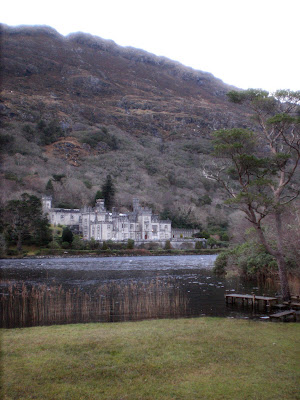 This castle was built in the 1860s and is considered Ireland's most romantic building. Mitchell Henry, a politician of the time, built this castle for his wife. At the time, the castle cost $1.8 million to build (in the currency of that time). Just imagine what it would cost today! When Henry's wife died, he began to spend less time in the castle. Shortly afterward, one of his children died, and he could not bear to live in the castle any longer. It went on the market and was sold to an individual who did not take care of the castle like Mitchell Henry did. Years later, it went on the market again and became an abbey. The castle used to house hundreds of nuns, however, it has thinned out in recent times. Currently and unfortunately, there are only five nuns left in Kylemore Abbey.
 Well that was my tour on Saturday! It was so exciting to see the Irish countryside for the first time since I had been here. Next I'll update about the sites that I toured on Sunday!